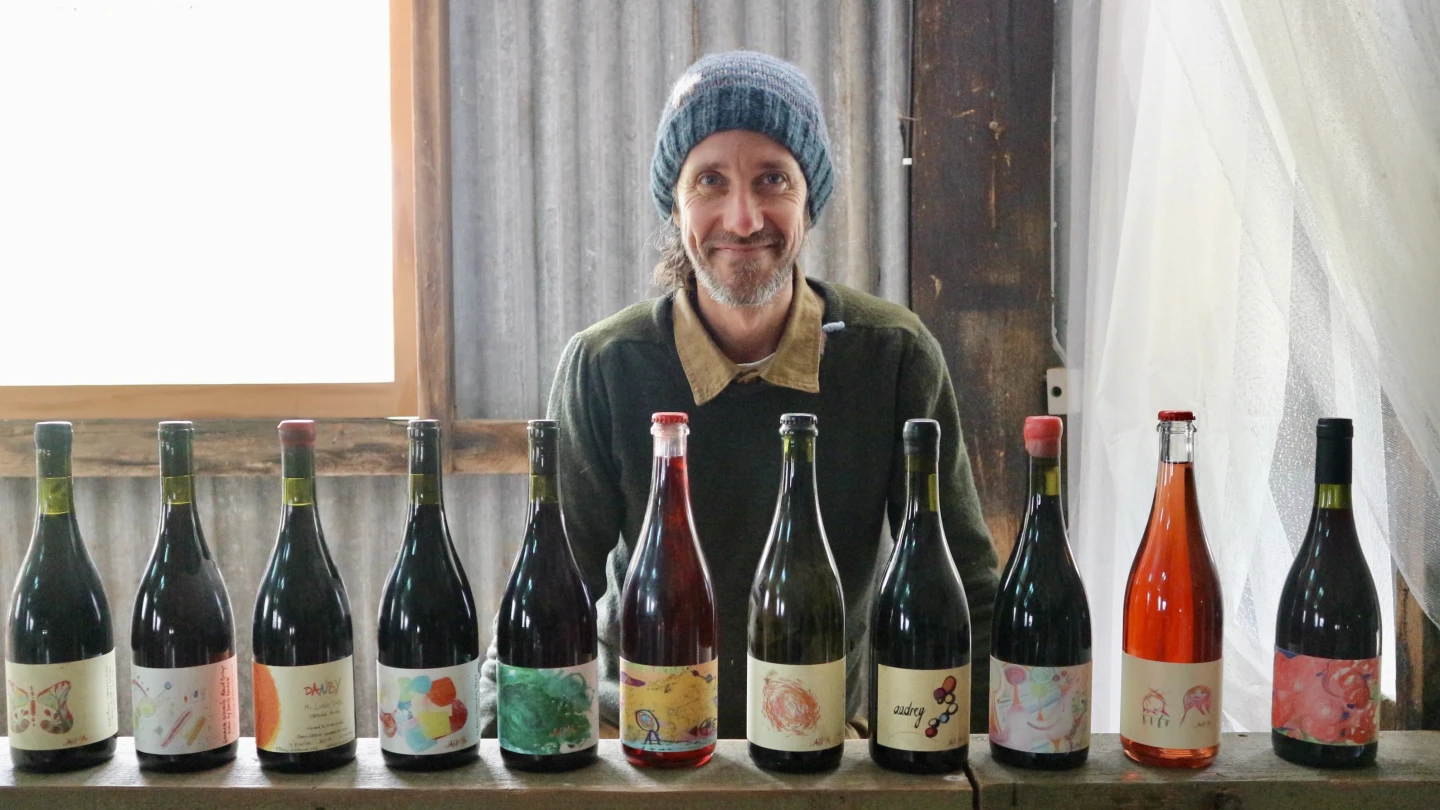
Unlike the usual polished figures in the wine industry, who typically appear in elegant suits and carry themselves with a certain gravitas, James Erskine stood out as a true “freak”. His simple clothes, unruly hair, and wild, free-spirited demeanor defied the norms. He is the man who broke the stereotypes surrounding wine and emerged as a pioneer of the natural wine* movement in Australia.
I had the privilege of meeting James Erskine, the owner and winemaker of Jauma, a well-known natural wine producer in Australia, during a talk show hosted by the Saigon Sommelier Association. James’s appearance reminded me of the humble, rustic winemakers who tend to their vineyards, but his mindset brought to mind Elon Musk—a “freak” who has changed the world.
Breaking the Mold and Cultural Norms
James didn’t come from a winemaking family. Instead, his rich life experiences, along with his learning from around the globe, including working in England, Japan, and Germany, gave him a unique perspective. His journey with wine began while studying to become a cook, when he took a wine course on German wine. Tasting Riesling for the first time captivated him, leading him to pursue an education in agriculture and soil.
In 2008, James took the Court of Master Sommeliers (CMS) exam and got top score. A year later, he was voted Gourmet Traveller Australian Sommelier of the Year and secured the prestigious Negociants Australia’s Working with Wine Fellowship. However, James wasn’t inspired by the cookie-cutter teachings of conventional wine education, where schools teach a standard formula that encourages winemakers to produce wines in exactly the same way. James has always respected the inherent uniqueness of wine. His career began 20 years ago, when Australian wine was still in its infancy, heavily influenced by colony countries. “They teach you how to taste Cabernet Sauvignon, and the wine judges are always right—you need to describe it just as they do. If you describe it incorrectly, you have to relearn until you can describe a Cabernet Sauvignon exactly as the judges say,” James remarked with heavy sarcasm.
Australia, in its early days of wine development, was deeply influenced by the culture of wine critics, and winemakers in the wine regions strictly followed the guidance of professional winemakers—a phenomenon James referred to as a “culture in culture.”
At that time, James was also trained to be a judge—a person with the authority to declare whether a wine was good or bad. On one occasion, James praised a natural Riesling, noting its excellent structure, but his assessment was rejected because Riesling had never been described in that way before. That was the moment James realized something wrong here.

First Principle Thinking
The more James delved into the world of wine, the more his sensitivity heightened. His senses developed, allowing him to experience wine actively rather than just consume it passively. At that time, James didn’t fully understand what natural wine was, but he knew he preferred wines without sulfur, without additives. Why not try to create wines that reflect their intrinsic beauty? This was the question James and his two fellows pondered, leading to the birth of their natural wines.
A distributor in England was impressed by what James and his fellows were doing and decided to place an order—their first export. However, the wine failed to meet the approval standards for export because it was “cloudy.” They were extremely worried since the distributor had already transferred the payment, and they certainly didn’t want to return the money for this reason.
Unwilling to accept this, James confronted the committee and found the reasons:
“Why did you reject our wine?” James inquired.
“Because your wine is cloudy,” the panel replied.
“Why is cloudy beer acceptable, but cloudy wine is not?” James continued.
Armed with his deep understanding and determination to uncover the core of the issue, James persistently questioned the panel to the point where his friend subtly suggested to the panel, “James is excellent at this—he could even blind taste with you if you’d like.” Although no blind tasting occurred, the matter was eventually resolved.
This story of James reminded me of Elon Musk’s first principle thinking.
First principle thinking is about seeing the world, understanding the essence of things, and making decisions based on that understanding. However, in life, we often follow similar thought patterns, imitate what others have done, and become mere shadows of others. When Elon Musk wanted to cut costs at SpaceX, he was met with regulations from the military and NASA, which he challenged by asking for the names of the people who had written those rules. Musk persistently reminded everyone that even the military and NASA’s requirements should be treated as suggestions, and the only unchangeable rule is that which is bound by the fundamental principles of physics. Start by thinking about the essence of things, unconstrained by regulations or past experiences, avoid comparisons, and look through to the core of the matter. Thanks to his innovative original thinking, SpaceX was able to significantly cut costs, reducing rocket production costs to just one-tenth of the usual price.
This same innovative thinking helped James become a pioneer in the natural wine movement in Australia. He won the Young Gun of Wine Winemaker’s Choice award in 2013.
The “Freak” Full of Joy
James is not just a talented winemaker; he is someone who lives fully in line with the values he passionately pursues. It’s as if James possesses an innate understanding and unwavering belief in everything he does. Reality has borne out this conviction—today, Jauma has become one of the foremost names in natural wine, exported to 15 countries worldwide.
When I asked what fuels his love for his work, he replied, “Wine is my passport to explore the world and meet incredible people.” James embodies the wild, natural beauty of life, exuding an extraordinary happiness and joy. It seems he has infused this zest for life into his farm, the people around him, and the wine labels he creates.

Reflecting on the rapid change and development of Australian wine over the past 20 years, and stories like James’s “freak” mindset, encourages me to always see things from a different perspective, unbound by the opinions or standards of others.
Reflecting on the rapid change and development of Australian wine over the past 20 years and James’s “freak” mindset has inspired me to always look at things differently, without being constrained by the opinions or standards of others.
Phuong Maxy Storyteller
Picture: Saigon Sommelier Association
*Natural wine is made from organically or biodynamically grown grapes without the use of chemicals in the vineyard. The winemaking process is minimalistic, with no added industrial yeast, no filtration, and no use of preservatives or additives. Natural wine often has a distinctive taste that reflects the unique characteristics of the vineyard where the grapes were grown.