What drives a Vietnamese woman, a PhD in environmental science with a successful career in Sydney, to leave it all behind and become a grape grower, ultimately winning the prestigious AgriFutures Rural Women’s Award in Australia?
I had the privilege of speaking with Hai Anh on an early morning, where she sat surrounded by the Tasmanian wilderness, bathed in golden sunlight and birdsong. Despite being thousands of miles away in bustling Saigon, I felt transported to her serene corner of Tasmania.
Tasmania, Australia’s southernmost island, is famed for its unspoiled beauty and rich natural biodiversity. Encircled by the Tasman and Indian Oceans, this land is graced with majestic mountains, pristine beaches, and lush forests—home to rare species of flora and fauna.
About Mrs. Hai Anh
Hai Anh’s journey:
- She was born and raised in Hanoi, Vietnam.
- Graduated from the University of Construction in Vietnam, specializing in environmental engineering.
- Earned a Master’s in Engineering at the University of Ottawa in Canada.
- Completed her PhD at the University of Massachusetts, USA.
- Currently a technical advisor for AgriFutures, a leading research and agricultural management organization in Australia.
- Serves on the environmental board in Tasmania, overseeing issues like climate change and biodiversity conservation.
- Recipient of the 2019 AgriFutures Award for her contributions to agriculture.
- Owner of Torch Bearer Winery in Tasmania, Australia.
- A dedicated wife and mother to two daughters.

The Unexpected Path to Vineyard Ownership
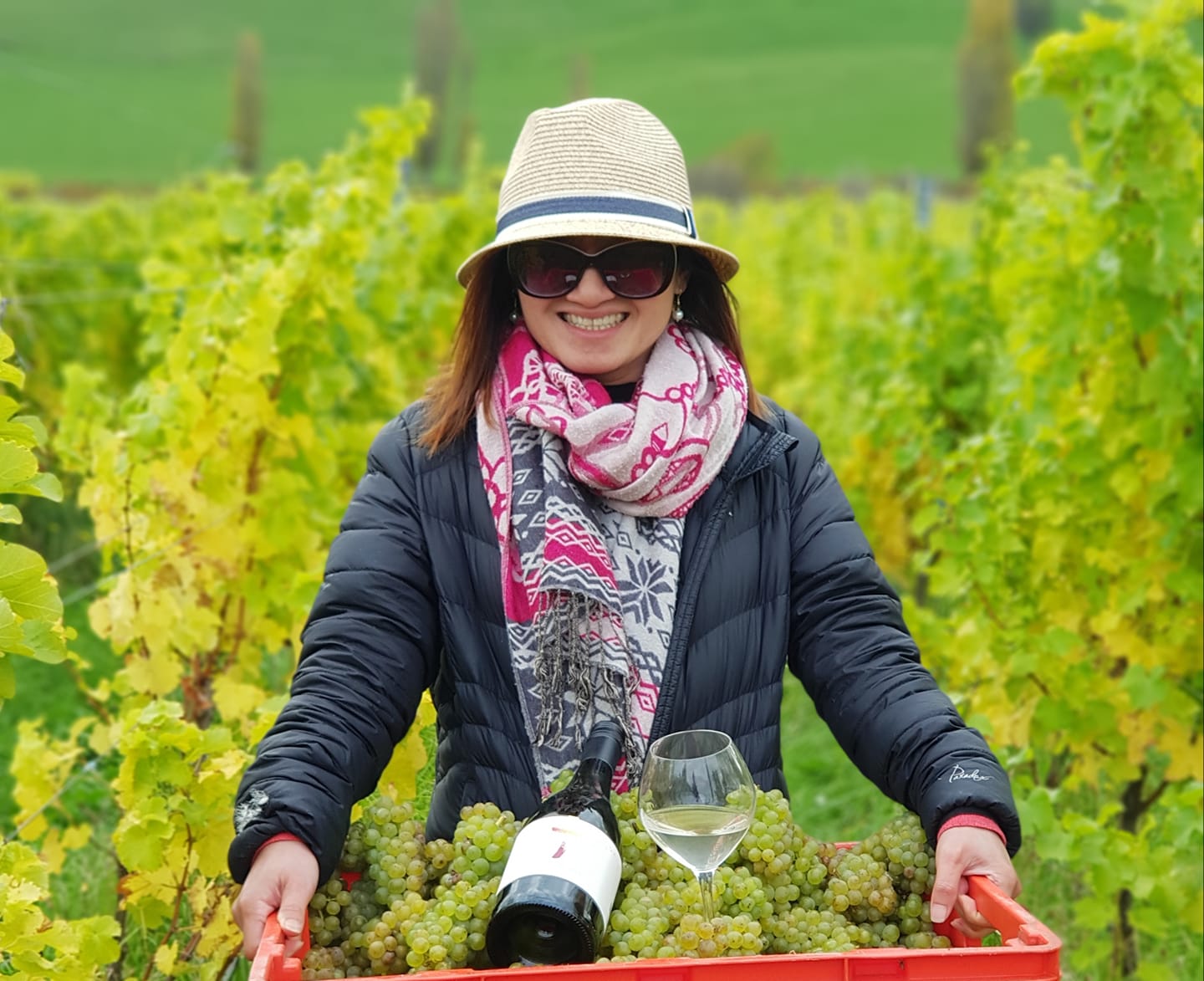
Hai Anh and her husband once led busy professional lives in Sydney, where she worked as an engineer for an innovative water treatment company. During a business trip to Tasmania, she was captivated by the island’s beauty and enchanted by a unique wine she tasted there. The quality of Tasmanian wine took her by surprise, and by serendipity, the vineyard she visited happened to be for sale. After thoughtful discussions with her husband, they decided to buy it, envisioning an early retirement plan centered around the vineyard.
Interestingly, instead of easing into a quieter life, this new venture made her busier than ever. We shared a laugh about her transition from a typical “9 to 5” office role to a “5 to 9” lifestyle, a schedule that leaves little room for rest. In 2017, with ownership of the vineyard secured, Hai Anh committed to producing wine using biodynamic principles, completely avoiding chemical intervention—a decision fueled by her environmental engineering background and her respect for sustainable, natural agriculture.
Their seven-hectare vineyard lies in Tasmania’s coolest valley, an ideal environment for crafting wines of unique character. Unlike Australia’s other wine regions, which harvest as early as December (Hunter Valley) or in March (Adelaide Hills), their vineyard’s harvest takes place in late April and early May. Though Tasmania produces only 1% of Australia’s wine, its vintages are celebrated for their distinctiveness and quality.
Starting from Scratch in Winemaking
As someone with no prior knowledge or experience in winemaking, I was genuinely curious about what gave Hai Anh the courage to buy a vineyard and dive into this unfamiliar world. She smiled and said, “I sought help. One of the things I love most about this industry is the generosity of the people. Everyone is eager to help one another in a way I’ve never seen in other fields.”
In the early days, she would drive from one vineyard to another, knocking on doors to meet the best biodynamic winemakers in the area. Her persistence was rewarded when an elderly couple, deeply knowledgeable in biodynamic practices, welcomed her in and shared their years of experience without reservation. “Whenever I faced challenges, they were there to guide me,” she shared. “They never held back any secrets. They were once helped by others, and now they’re passing on that knowledge to me, just as I will one day pass it on to others.”

Overcoming Challenges
Before our conversation began, Hai Anh made one request: “Please, don’t make this work seem glamorous. Only those who actually do it understand how tough it is.”
She purchased her winery in 2017, inheriting vines accustomed to conventional farming methods. Determined to cultivate biodynamically, she stopped using fertilizers and pesticides altogether. This commitment came at a high cost; in those first two years, she faced near-total crop loss. Weather was unpredictable, frost would settle, and budding vines were damaged—a constant heartache for Hai Anh.
Despite these setbacks, she remained steadfast. By the third year, she decided it was time to find solutions. With a background in engineering, she developed an automated system to protect the vineyard from frost, and gradually, the yields began to improve.
Reflecting on her transition from office work to labor-intensive vineyard management, she joked, “I’ve never felt as poor as when I’m mending nets, yet as rich as when I have a surplus of manure.” She fondly recalled patching up torn nets with her husband, working to protect the vines from birds—a simple, yet memorable task.
Hai Anh laughed as she recounted the unexpected roles that come with vineyard life, like chasing off sheep, geese, and ducks determined to snack on her grapes.
Winemaking as a Path of Self-Discovery
Hai Anh has always been drawn to challenges, and winemaking has brought out her inner resilience. “It’s a profession that not only brings joy but has taught me so much about myself,” she reflected. Winemaking has sharpened her persistence and patience, instilling in her a deeper connection with nature. “Wine teaches you to adapt to things beyond your control.”
Today, she monitors the vineyard’s temperature several times daily, each stage of grape growth under her watchful eye. “The quality of the grape largely defines the quality of the wine,” she said, underscoring the meticulous care that biodynamic winemaking demands.

The Only Asian Female Winemaker in Tasmania
In 2019, Hai Anh’s dedication and innovations at Torch Bearer and her contributions to the Tasmanian community were honored with the prestigious AgriFutures Rural Women’s Award. This Australian accolade celebrates female leaders in agriculture, business, and community development, recognizing those who make an impact today while envisioning a better future.
When asked about her experience as the only Asian winemaker in Tasmania, Hai Anh laughs, admitting that it wasn’t something she considered at first. Yet, as others pointed it out, she began to see the advantage her fresh perspective brought to an established industry. As she describes it, “Vietnamese people have a meticulous nature—like skimming broth when making pho—and a creativity that’s essential for biodynamic winemaking.” These qualities, along with the resilience deeply ingrained in her culture, have been invaluable assets in her journey.
Hai Anh reflects on the resilience of Vietnamese people, especially in the face of adversity. She recalls the central region of Vietnam, where storms strike year after year, yet the communities rebuild tirelessly each time. “Sometimes, resilience is just there within us without us even realizing it,” she shares, recounting her own challenges through seasons of frost that forced her to start over but never give up.
Torch Bearer and Dreams
“Why did you name your winery Torch Bearer?” I asked, intrigued.
“It symbolizes my dreams and vision,” she replied with a knowing smile.
The name came to her after acquiring the vineyard, inspired by the idea of being a “torch bearer.” Like the Olympic torch passed between athletes to honor the spirit of the games, she hopes her wines will act as a guiding light. For her, wine is more than just a drink; it’s a medium for sustainable business, environmental preservation, and biodiversity. Her vineyard is a testament to this commitment—an embodiment of sustainable development, where each vintage tells a new story through every bottle.
Beyond production, her ambition is to bring Torch Bearer wines to the world, especially to Vietnam. She dreams of making wine a cultural experience in her homeland—a refined pleasure, rather than just a means to intoxication.
Additionally, she’s passionate about challenging stereotypes around race and gender in the wine industry. Although it remains a field traditionally dominated by men and white professionals, she refuses to let such barriers define her journey. Instead, she is determined to establish her place and value through the quality of her work.
Torch Bearer’s annual production remains modest, with only a few tens of thousands of bottles, most of which are consumed within Australia. Yet, the wines have secured a place on the coveted wine lists of fine dining establishments and “hatted” restaurants—a ranking system in Australia similar to the Michelin Guide. When I researched Torch Bearer wines, I was pleasantly surprised to find that Mike Bernie, a highly influential wine critic in Australia, had awarded exceptionally high scores to many of her wines, with some reaching up to 95 points.
I had the opportunity to taste her wine at NOB bar, a natural wine bar, and was captivated by its unique character, distinct from other Australian wines I’ve tried.

Hai Anh’s story is not merely a personal journey but also an inspiration to young people who dare to explore new horizons, pursue their passions, and do what they love. Her narrative resonated with me, particularly during challenging moments in my own path. At times, I’ve asked myself, just as she once did, “Why choose the rocky path when a smoother one is available?” But only those with the DNA of adventure and the spirit of discovery can understand such a choice.
Hai Anh’s daring “early retirement” to pursue this passion has led her on an exciting journey, filled with unexpected twists and delightful surprises. True happiness, as she embodies, lies in the journey itself, not merely the destination.